
When I was in the early stages of my career, the best leaders were often considered to be those with all the answers, the visionaries who could set and drive the direction from above. However, times have changed dramatically.
Technology has transformed the world of work from local to global, and the increasing pace of change and lack of clarity about the future demand a different approach to leadership. To top it off, global events like the COVID-19 pandemic have accelerated and highlighted what was pre-existing or inevitable.
It no longer makes sense to base your leadership on an outdated ideal. Rebecca Knight’s article in the Harvard Business Review about 6 Essential Leadership Skills – and How to Develop Them refers to how the evolution of work has necessitated a change in leadership styles.
In this piece, she quotes Kirstin Lynde, founder of the leadership development firm Catalyze Associates, who eloquently stated, “The best leaders in the twenty-first century are question askers. They seek feedback and new perspectives, and they ask curious questions about themselves, their teams, and their environment.”
I couldn’t agree more with Kirstin’s perspective. However, the essential leadership skills described in the article will only get you so far.
Over the past few years, I’ve been grappling with the question of what skills are required if what it takes to be a successful leader has changed.
I agree the 6 skills emotional aperture; adaptive communication; flexible thinking; perspective seeking, taking and coordinating; strategic disruption skills and resilient awareness are essential but they’re only part of what is needed. If you were hoping for one leadership skill to focus on like a magic bullet, you’ll be disappointed to discover my research indicates a broader, integrated set of skills are required.
It starts with a deep awareness of who you are, how you can be, and how you want to be experienced as a leader. However, that understanding must be coupled with the ability to act in alignment with both your inner and outer worlds.
This journey of introspection and alignment led me to conceive the idea of following a Centring Star that enables you to navigate the storms and turbulence of leadership while staying true to yourself.
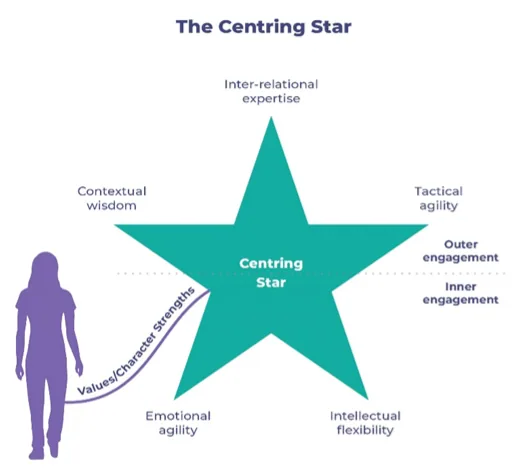
The first step in this process is to know your values and character strengths. The second step is to align with these values and strengths as you use the groups of skills captured in the Centring Star to navigate your path.
Like the HBR article, I believe there are six essential leadership skills, which I categorise under the broad headings of:
1. Acting in alignment with values/character strengths, and exercising
2. Emotional agility
3. Intellectual flexibility
4. Contextual wisdom
5. Interpersonal expertise, and
6. Tactical agility.
In developing the Centring Star framework, I reviewed substantial evidence from various leadership studies, theoretical frameworks and psychological research. This extensive review confirmed the necessity of taking an integrated approach to leadership that balances personal values with adaptive skills in a rapidly changing environment.
I liken it to a being able to move from a perfect storm where it can feel as though the tumultuous waves are dragging us under to regaining self-control and clarity by:
- finding and centring yourself in the calm eye of the storm
- seeking to understand what’s going on for you internally and in the outer world that’s affecting whatever you’re leading in that moment and
- keeping an eye out for what’s next.
The Centring Star acts as your guide, helping you navigate out of the eye, face the challenges, and repeatedly find your way back to the calm.
This process ensures that you remain true to your core values while effectively steering through the converging storms of modern leadership.
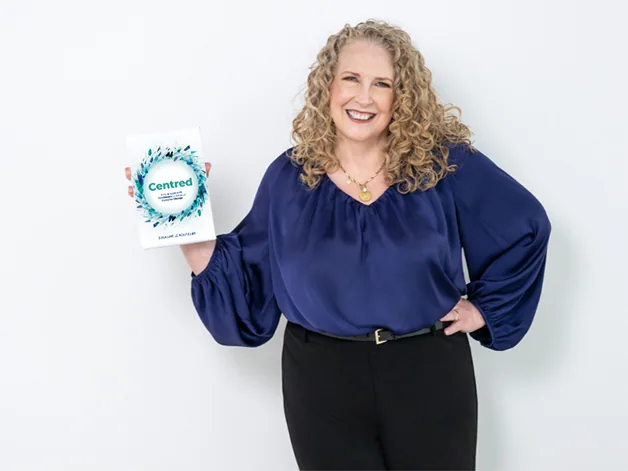
In my book, “Centred: How to Lead with Confidence in Times of Complex Change,” I delve into these skills and how you can harness them to become a more effective, confident and authentic leader.
If you’re in Australia you can purchase a hard copy from www.susanneleboutillier.com. If you’d prefer an e-reader version or you’re somewhere else in the world you can buy if from Amazon US, Amazon UK, Barnes and Noble and Apple iBooks.