Over the last year, I’ve been working on my first book in spits and spurts. In the last couple of months, I’ve pushed myself to get it finished. It was a big moment this week when I knew I could put my hand on my heart and say the draft manuscript is finished. It’s now going through the final editing process. It’s about how we can be more centred and lead with confidence in times of complex change. It will be available for pre-sale soon.
As I was finishing the manuscript, I realised a sub-model had emerged. It’s not the complete answer for how to centre yourself in complex change – you’ll have to wait for that!
However, it’s a good place to start. In an age that emphasises the skills we will need for the future, we can forget about the value of wisdom.
Wisdom and skills are deeply intertwined, but you cannot develop wisdom without experience.
When writing Centred, I realised there are three distinct types of wisdom, and we need all three to lead in complex change confidently.
Daniel Goleman has written extensively about the importance of emotionally intelligent leaders possessing personal and people wisdom. His model of emotional intelligence describes how self-awareness and self-management enable the exercise of personal wisdom, while social awareness, empathy, and social skills are required to enable the exercise of people wisdom.
You cannot develop personal and people wisdom without reflecting on past successes and mistakes, so that you know when to act and when to step back.
However, when leading complex change, you need more than personal and people wisdom. You also need contextual wisdom. Personal and people wisdom are like a compass that helps you find your direction, but without a map (contextual wisdom), you may not understand the terrain you’re navigating.

You must understand the broader environment in which you operate and apply that understanding to your leadership decisions. This involves recognising that context shapes your every decision and action. You must continuously scan for emerging trends and shifts, use your intuition and fit-for-purpose tools to interpret the changes and shape your next steps to fit the specific circumstances.
Applying your wisdom in context anchors your leadership in the present and enables you to answer the question, ‘What’s the next right step?’
We expand the possibilities when we value and develop different types of wisdom.
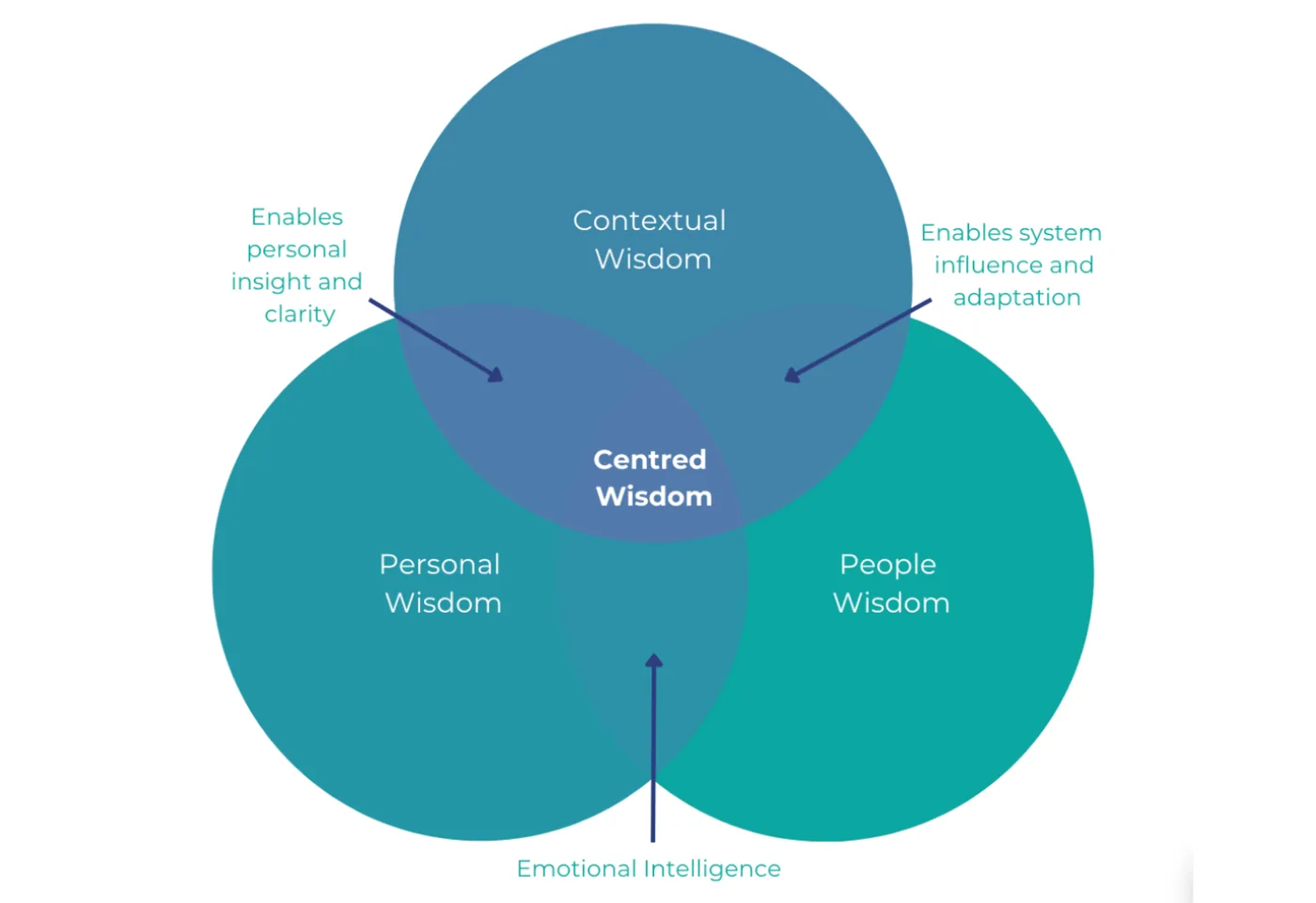
Combining contextual and personal wisdom enables us to develop personal insight and clarity as leaders. When we add social wisdom into the mix, we create the conditions needed to influence the different actors in the system to change and adapt to the emerging context.
Dave Snowden, founder and chief scientific officer of The Cynefin Company, a consultancy specialising in complexity and sensemaking, said, “There are few if any context-free solutions, but many valid context-specific ones.”
So, the next time you have a problem to solve, remember to apply your contextual wisdom along with your personal and people wisdom.