

In October a group of senior leaders from health, community and human services had a conversation over breakfast in Darwin. Chief executives, senior managers and practice leaders, from small local services through to arms of national organisations, in different seats in the same system. The Chatham House Rule applied, so nothing here is attached to a person or an organisation.
The question in front of the room was “Where do you need to land, by when, and what are you doing with the time before you get there?”
It was also the first time I had put the five signals from The Convergence Trap in front of a Darwin room. Each one on its own looks like a manageable strategic risk, which is how boards tend to receive them. Read together, they narrow an organisation's options and shorten the time it has to respond.
My read, which I put to the room before we started, is that the problem is rarely the amount of change on its own. It is change that arrives without a why, without a date, and without the people closest to it being part of working it out. Slowing down does not fix any of those three.
Everyone was pacing more than one change
Every person named at least two. Award and pay rate changes that lift costs and change how you attract people into roles. Funding that has not moved with expectations. Reform programs landing on the same staff. Legislation changing often enough that responding to it is a job in itself. Leadership turnover at board and executive level. Growth for some and contraction for others.
The common line was doing the same with less and the need to find efficiencies to create sustainability.
Reserves are being used to keep the doors open
Reserves came up in two forms. Some organisations have treated unspent government funding as a reserve, which only holds while government lets you keep it, and that flexibility is being removed. Others have genuine reserves built over years and are drawing on them to keep services running rather than to fund something new. That is the more serious signal of the two.
Operating in the Territory is a different job
The pattern of people changing roles roughly every three years, means relationships that took time to build leave with the people who held them. Influence has to be broad rather than resting on a few individuals, because the individuals move on.
Parts of the system that exist elsewhere are missing in the NT. The volunteer layer is one, so organisations absorb work volunteers tend to do pro bono in other jurisdictions. And a local organisation cannot match a national one, which can also bring philanthropic funding from interstate.
Underneath it, the Territory's debt position means the funding picture is unlikely to shift without Commonwealth intervention. And that level of government is facing its own challenges and is unlikely to bridge the gap.
The strongest thing said about the Territory came near the end. Working here takes a level of resilience people in larger jurisdictions do not have to find. People get tired and leave and the ones who stay do so deliberately. Resilience should be named and celebrated with peers rather than assumed.
You have to make the case in their currency
This applied to boards and to government, and the same thing goes wrong in both.
With boards, the tension is between the impact you want to have and what it will cost. The case gets made in the first and judged on the second. It was agreed numbers are only as powerful as the story attached to them.
The next part is my read rather than the room's, from about thirty years inside government including leading investment and commissioning.
Organisations tend to approach government heart first, with a case built on who needs the service and why it is the right thing to do. There is usually real merit in it. It is also not what gets funded. Government funds the problems it already has: election commitments, policy priorities, and whatever is in the media causing it difficulty. Advocacy can work when it is sustained, evidenced, well timed, and aimed at the people who can move the decision.
Your first team is the one beside you, not the one below you
A concept that generated interest was Patrick Lencioni’s First Team. Most leaders think of their team as the people who report to them. If every member of an executive does that, each optimises for their own area and the organisation produces silos by design.
The alternative is that your first team is your peers at your own level and your direct reports are your second team. The executive works out together how a change will land and where morale and psychosocial risk are showing up, before any of it goes down the line. Two refinements came from the conversation: the chief executive sits inside that team rather than above it, and the executive, not only the chief executive, should be visible to the board.
Crossroads leadership
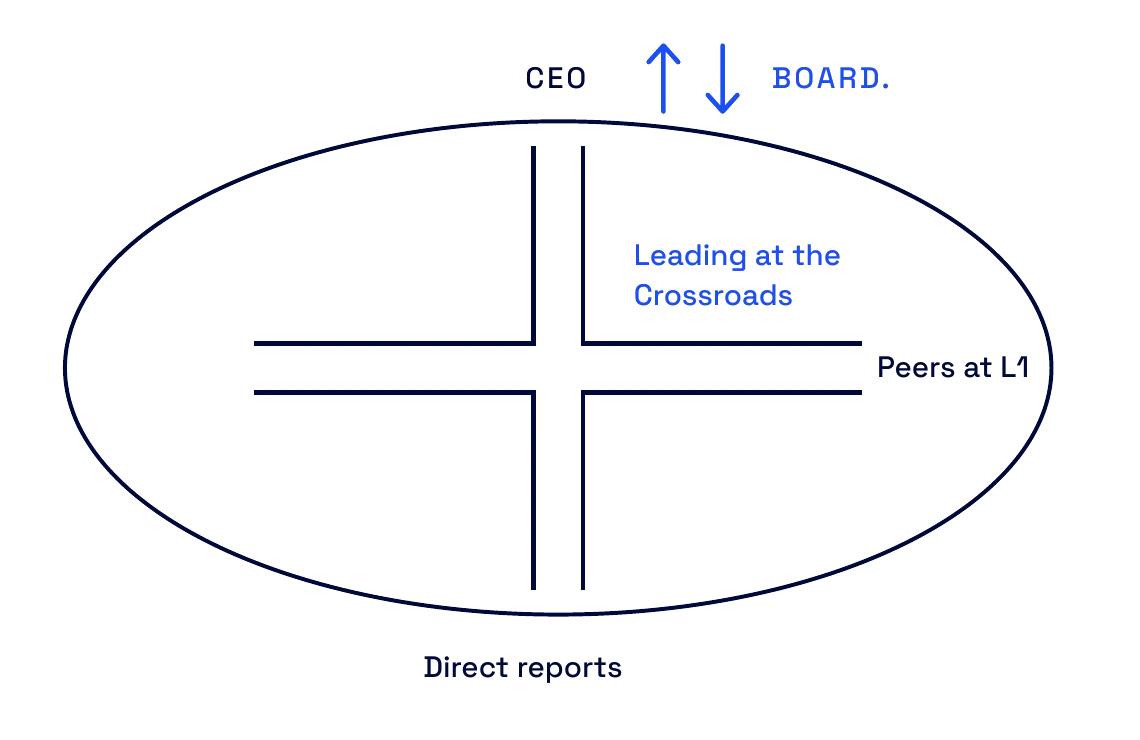
You have a first team. You still have to report up, and you still have to lead your team.
Slowing down only works if you know how much time you have
The instinct when people are already stretched is to slow a change down to protect them. The cost is twofold. The deadline arrives anyway, so time spent going slowly comes out of the time people had to adjust. And you act on untested assumptions about how your team will respond. Two people named this in themselves. One had slowed the pace because the rate of change felt too fast and, on reflection, was not sure it had been for the right reasons. Another noticed that when the pace slowed, some staff took advantage of it.
The move is not to go faster. It is to put a date in the ground, work backwards from it, then decide deliberately where you can afford to go slowly and where you will need to pick up.
What people are taking back
Work out who your allies and partners could be, locally and nationally, before you need them.
Put a date in the ground and work backwards from it.
Change how progress is reported. Red, amber and green hides work that has not started, so add percentage complete and give not started its own status.
Build the executive as a first team and find an external critical friend.
Bring the strategic plan to life inside the team, so it is not a document the board produced.
Review what you are doing in order to decide what to let go of. The hardest of these, and the one most likely to free something else up.
The Wider Lens is a morning for senior leaders in health, community and human services, with curated tables under the Chatham House Rule. The Peer Room is a breakfast for chief executives. Email susanne@lebout.com.au if you would like an invitation to either, or to put one of your senior leaders forward.