
Confidence Without Curiosity Is a Risk in Disguise
In 2003, Ducati re-entered MotoGP with a beginner’s mindset.
They weren’t expected to win—they came to learn.
And they did.
First race: podium.
Mid-season: a win in Barcelona.
End of season: second in the Constructors’ Championship—behind only Honda.
Then in 2004, they stopped asking why it was working.
Assumed success was all down to them.
Ignored other factors—context, conditions, timing.
And that’s when performance slipped.
Design flaws. Poor decisions. Overconfidence.
They weren’t beaten. They were caught out by their own certainty.
As Ducati’s Technical Director Filippo Preziosi put it:
“In racing, teams often care only whether a change improves performance—not why it works.”
— Filippo Preziosi
Early Warning Signs Don’t Always Come with Alarms
Ducati didn’t fall behind because they lacked skill. They fell behind because they stopped questioning what was driving their success.
That same pattern plays out in executive teams. Success masks early signals—decision shortcuts, mounting pressure, subtle misalignment.
Leaders stop challenging the model because the scoreboard still looks good.

But the Centre for Creative Leadership’s 2025 global data is clear: Senior executives are grappling with:
- Conditions that keep shifting—regulations, markets, competition—but teams still need to deliver
- Strategy that must align across functions, not just sit on paper
- Influence that needs to flex—what worked before doesn’t always land now
- Expectations about future-readiness, even when resources are tight and the signals are unclear
- Cooperation that falters—especially when roles change or unspoken tensions linger.
These are signs it’s time to pause and reassess—before momentum becomes drag.
It’s the difference between racing flat out… and knowing when to ease off the throttle to check your line before the next corner.
In Complex Change, Leaders Need More Than Speed
The patterns I see in executive teams:
- Relying on what used to work—even when the context has shifted
- Pushing hard to sustain results—but absorbing the hidden cost
- Strategic calls made fast—but not always collectively or consciously
- Teams delivering—but under pressure that’s rarely discussed.
When pressure peaks, most executive teams focus on performance. Few stop to examine the leadership system behind that performance.
That’s why I offer a focused, half-day workshop for senior executive teams navigating complex change. It’s built around the Centring Star™—a practical, evidence-based framework for leading complex change with confidence.
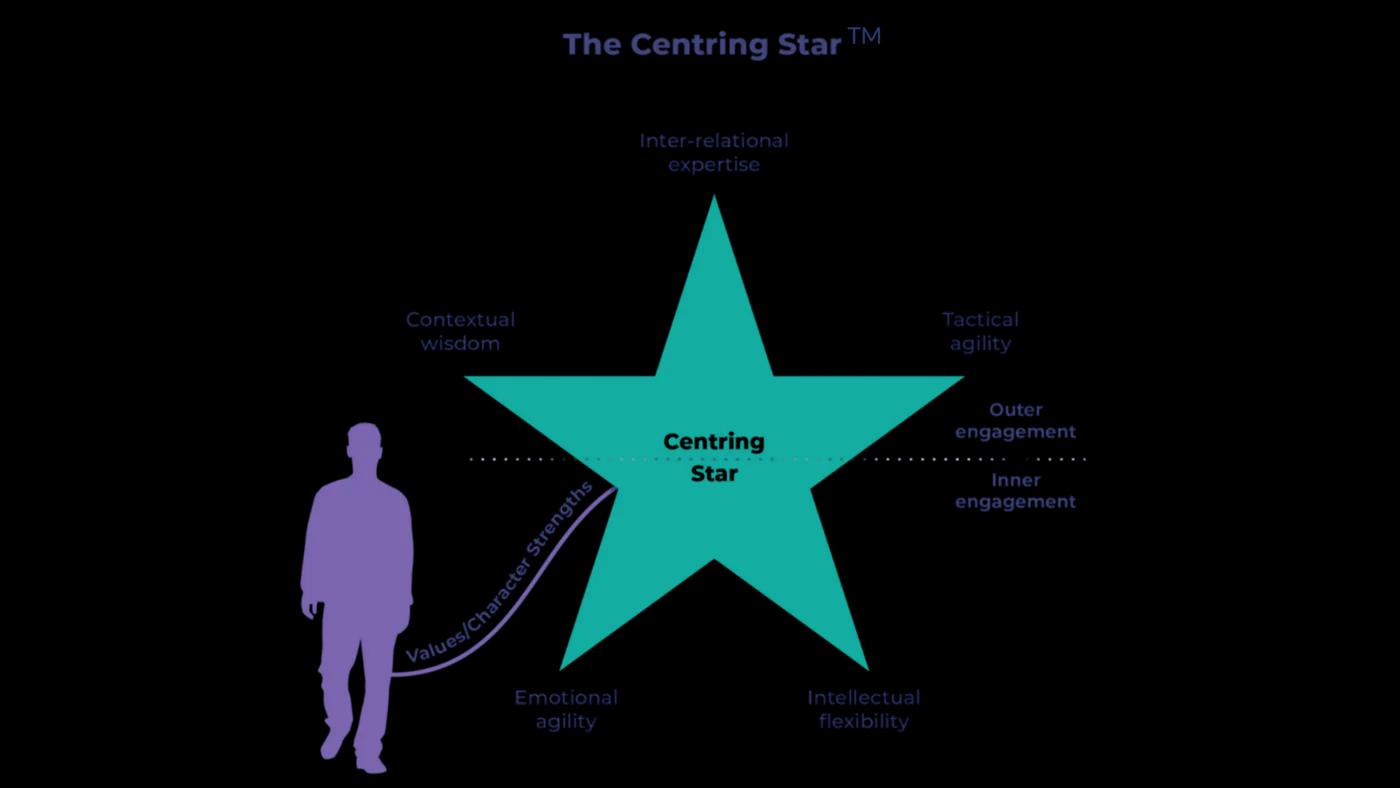
It brings together the core capabilities leaders need when conditions shift and certainty disappears.
It enables teams to recalibrate how they think, decide, and align—without losing momentum or burning out key people.
Teams walk away better able to:
- Improve strategic decision-making when uncertainty is high
- Adapt without losing cohesion or momentum
- Surface reactive patterns that may be creating the very problems you’re trying to solve
- Build a shared view of what matters—so effort and outcomes align
- Work in a way that holds—without needing to hold everything yourself.
What you gain:
Not a reset. A recalibration.
Not theory. A practical framework that strengthens leadership judgement where it matters most.
If your team is delivering—but starting to feel the stretch— Let’s start with a 20-minute confidential consult to see if this fits – book here.